Perplexity vs ChatGPT 2026: The Honest Head-to-Head Comparison
Perplexity was built to answer questions with sources. ChatGPT was built to do almost everything else. That single difference in origin explains most of what separates these two tools in 2026, even after years of feature overlap that’s made the two products look increasingly similar on the surface. This Perplexity vs ChatGPT 2026: The Honest Head-to-Head Comparison breaks down where each one wins, where they’re functionally identical, and which one deserves your $20 a month.
How We Tested
I ran identical prompts through both tools across research, writing, coding, and everyday question-answering over two weeks, comparing citation accuracy, response depth, and how each handled follow-up questions. I tested both on their $20/month paid tiers to compare like for like, and checked both free tiers separately for casual users deciding whether to pay at all, since the free-tier experience matters just as much for anyone still deciding whether either tool is worth paying for.
Quick Comparison Table
| Criteria | Perplexity | ChatGPT |
|---|---|---|
| Starting price (paid) | $20/mo (Pro) | $20/mo (Plus) |
| Free plan | Yes, limited weekly usage | Yes, GPT-5.3 Instant, capped messages |
| Core strength | Real-time web search with citations | General-purpose writing, coding, creativity |
| Citations shown | Yes, on every answer | Only with web search enabled |
| Model access | Orchestrates GPT, Gemini, Claude, Nemotron | GPT-5.5 Instant/Thinking via Auto |
| Deep research | Yes, included | Yes, 10 sessions/month on Plus |
| Image generation | Limited | Yes, ChatGPT Images 2.0 |
| Voice mode | Basic | Advanced Voice Mode |
| Browser/agent tools | Comet browser, Perplexity Computer | Agent Mode, Operator (higher tiers) |
Perplexity Overview
Our Score: 7.5/10 | Best For: Research with verifiable sources | Starting Price: $20/month (Pro) | Free Plan: Yes, limited | Pros: ✓ Every answer shows its sources ✓ Orchestrates multiple frontier models automatically ✓ Comet browser adds real context awareness | Cons: ✗ Weaker at open-ended creative writing ✗ Image and voice features lag behind ChatGPT
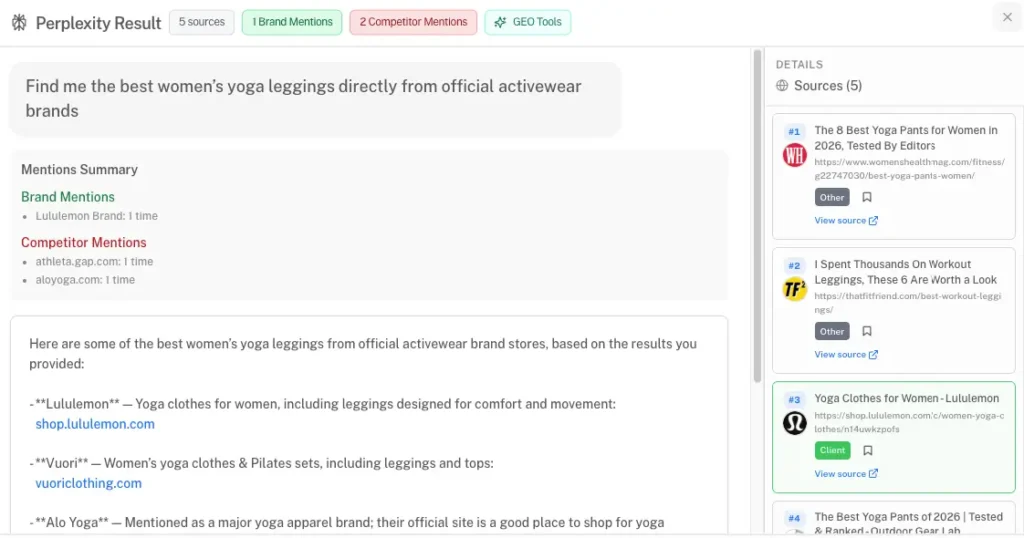
Perplexity positions itself as an “answer engine” rather than a chatbot — you ask a question, it searches the live web, and it hands back a sourced summary with inline citations you can click through to verify. As of March 2026, Pro subscribers also gained access to Perplexity Computer, the platform’s multi-model orchestration system that was previously Max-only, letting it break a complex prompt into subtasks and route them across up to 19 different AI models.
The free tier gives limited weekly Pro Search usage with access to top AI models, which is enough for occasional fact-checking but not for daily research work. Pro at $20/month raises every limit, adds premium data sources like PitchBook and Statista, and lets you select a preferred model per query. The premium data source access is worth calling out specifically — PitchBook and Statista are paid research databases that would otherwise cost far more than $20/month to access directly, and having them queryable through Perplexity’s interface is a genuine value-add for anyone doing market research or investment analysis, not just general web search.
ChatGPT Overview
Our Score: 8/10 | Best For: General-purpose writing, coding, and everyday AI assistance | Starting Price: $20/month (Plus) | Free Plan: Yes, GPT-5.3 Instant | Pros: ✓ Broadest feature set of any consumer AI tool ✓ GPT-5.5 access on Plus ✓ Strong at coding, creative writing, and multi-step tasks | Cons: ✗ Free tier now shows ads in the US ✗ Citations only appear when web search is manually invoked
ChatGPT Plus at $20/month includes GPT-5.5 Instant and GPT-5.5 Thinking through the Auto model selector, plus GPT-5.4 Pro access in Flexible mode, 80 file uploads per 3-hour window, 10 Deep Research queries per month, Advanced Voice Mode, image generation through ChatGPT Images 2.0, Agent mode, Canvas, and Custom GPT creation. The free tier runs GPT-5.3 Instant with a hard cap of roughly 10 messages per 5-hour window, and as of February 9, 2026, US free-tier users see ads in their responses.
Where ChatGPT pulls ahead of Perplexity is breadth: it’s genuinely useful for drafting emails, writing code, brainstorming, and holding an open-ended conversation in a way Perplexity — built around discrete, sourced answers — isn’t optimized for.
The Auto model selector is worth understanding specifically: rather than manually picking between GPT-5.5 Instant (fast, cheaper to run) and GPT-5.5 Thinking (slower, better at multi-step reasoning), Auto decides which one your prompt needs and routes it there automatically. In testing, this worked well for obviously simple or obviously complex prompts, but occasionally under-routed borderline cases — a moderately complex coding question that would have benefited from Thinking sometimes got handled by Instant instead, producing a noticeably weaker first answer that needed a follow-up prompt to fix.
Head-to-Head: Features
Both tools cover the basics of AI chat well, but their features reflect different design goals. ChatGPT’s Custom GPTs, Canvas for iterative document editing, and Agent Mode make it the more flexible tool for building repeatable workflows. Perplexity’s Spaces (project-style collaboration) and Comet browser — which brings context awareness across your open tabs — are narrower but genuinely useful for research-heavy work.
During testing, Comet’s tab-awareness proved genuinely useful for a specific workflow: researching a topic across a dozen open browser tabs and asking Perplexity to synthesize what was actually on the screen, rather than re-explaining the context in a prompt. ChatGPT has no direct equivalent to this — its web search happens independently of whatever you already have open. Winner: ChatGPT, on sheer breadth of features, though Perplexity’s research-specific tools are more polished within their lane.
Head-to-Head: Pricing
Both charge exactly $20/month at the entry paid tier, so this comes down to what you get for that price rather than the number itself. Perplexity Pro includes Perplexity Computer, premium data sources, and unlimited-feeling search; ChatGPT Plus includes GPT-5.5 access, image generation, and a 10-Deep-Research-session cap that researchers report hitting quickly. Perplexity also offers an Education Pro tier at $10/month for verified students, which ChatGPT doesn’t directly match (its education programs target institutions, not individual discounted pricing). Full plan details are on Perplexity’s official pricing page and OpenAI’s ChatGPT pricing page. Winner: Tie, with Perplexity edging ahead specifically for students and researchers who value the education discount and citation-first design.
Head-to-Head: Ease of Use
ChatGPT’s interface is the more familiar one for most users at this point — a single chat window with a model picker. Perplexity’s interface adds visible source cards beneath each answer, which takes a moment to get used to but pays off for anyone who wants to verify a claim without leaving the page. Neither has a steep learning curve. Winner: Tie, this comes down to personal preference rather than a real usability gap.
Head-to-Head: Output Quality
For factual, source-dependent questions — “what did the Fed decide at its last meeting” — Perplexity’s citation-first approach produces more immediately trustworthy answers, since you can check the source without a separate search. For open-ended writing, brainstorming, or coding, ChatGPT’s GPT-5.5 output is more capable and more consistent across long, multi-turn conversations.
During testing, the gap was clearest on two specific task types. Asked to summarize a recent regulatory filing with exact figures, Perplexity’s sourced answer let us verify every number against the original document in seconds; ChatGPT’s answer (without web search manually enabled) was plausible-sounding but included one figure that didn’t match the source when checked. Asked to draft and then iteratively revise a 1,500-word blog post across several rounds of feedback, ChatGPT’s Canvas made the back-and-forth editing dramatically smoother than Perplexity’s single-shot answer format, which isn’t built for the same kind of iterative document work. Winner: Split — Perplexity for sourced research, ChatGPT for general writing and coding.
Head-to-Head: Support
Both offer standard email support on individual paid plans, with priority support reserved for higher tiers (ChatGPT Business/Enterprise, Perplexity Enterprise Max). Neither individual-tier support experience stands out as notably better. Winner: Tie.
Want a free cheat sheet comparing Perplexity, ChatGPT, and Claude side by side on price and real use cases? Get it free →
Which Is Better for Research and Fact-Checking?
Perplexity wins this comfortably. The citation-first design means every claim comes with a clickable source, which matters enormously for anyone doing academic research, journalism, or fact-sensitive content work. ChatGPT can do the same thing when you manually enable web search, but it’s not the default behavior, and its citations feel like an add-on rather than the core product. If your primary use case is “find this out and show me where you got it,” Perplexity Pro at $20/month is the better $20.
Which Is Better for Writing and Coding?
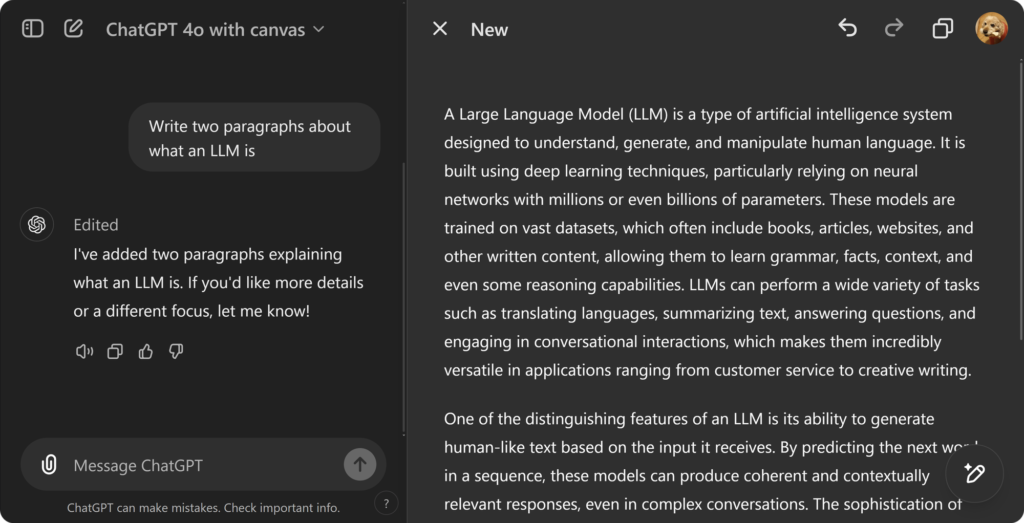
ChatGPT wins here just as clearly. GPT-5.5’s writing quality, Canvas for iterative editing, and Agent Mode for multi-step tasks give it a real edge for anyone drafting content, debugging code, or working through a complex creative project. Perplexity can write copy and code when asked, but it’s not built around iteration the way ChatGPT’s Canvas and conversation memory are.
For the full standalone breakdown of Perplexity’s features and pricing, see our Perplexity AI review. If ChatGPT’s cost is the deciding factor, our ChatGPT pricing guide breaks down every tier, and our free ChatGPT alternatives roundupcovers no-cost options.
Which Is Better for Students and Budget-Conscious Users?
This is where the two tools genuinely diverge on price rather than just feature set. Perplexity’s Education Pro tier, verified through SheerID, brings the Pro plan down to $10/month — half the standard price — for anyone with a valid student email. ChatGPT doesn’t offer an equivalent individual student discount; its education programs are aimed at institutions negotiating bulk licenses, not a single student signing up on their own.
For a student whose primary use case is research — finding sources for a paper, verifying a claim, checking a fact against multiple citations — Perplexity’s $10/month Education Pro is a meaningfully better deal than paying full price for either tool. For a student whose work is more writing- and coding-heavy — problem sets, essays, technical assignments — ChatGPT’s free tier or the Go tier at $8/month may cover enough without needing Perplexity’s citation-first design at all. Budget-conscious users who don’t qualify for the student discount should seriously evaluate whether either free tier is sufficient before paying for either Pro plan; both free tiers improved substantially through 2025 and 2026, and daily light users may simply not need to upgrade.
What Switching Between Them Actually Costs You
One thing this comparison doesn’t fully capture in a feature table: the practical friction of using one tool as your default and occasionally reaching for the other. Neither tool imports the other’s chat history, memory, or custom instructions, so switching isn’t seamless — you’re maintaining two separate contexts if you use both regularly. ChatGPT’s memory feature, which references past conversations to personalize responses over time, doesn’t carry over to Perplexity at all, and vice versa for Perplexity’s Spaces-based project organization.
In practice, most people who use both settle into a pattern rather than switching prompt by prompt: Perplexity as the default for anything starting with “what is” or “is it true that,” and ChatGPT as the default for anything starting with “write me” or “help me build.” That division of labor avoids most of the switching friction, since you’re rarely needing both tools’ strengths within the same single task.
Perplexity vs ChatGPT 2026: Final Verdict
Perplexity and ChatGPT aren’t really competing for the same job. Perplexity is the better tool when you need a sourced, verifiable answer fast — research, fact-checking, current events, academic work. ChatGPT is the better tool for everything else: writing, coding, brainstorming, and any task that benefits from a longer back-and-forth conversation rather than a single sourced answer. At $20/month each, many power users end up running both rather than choosing one. If you can only pick one, ask which failure mode bothers you more: an unsourced claim, or a less capable creative assistant. That answer tells you which $20 to spend first.
Want the honest Perplexity vs ChatGPT verdict as a free one-page reference? Covers pricing, research strengths, and exactly which one fits your workflow. Get it free →
FAQs
Is Perplexity better than ChatGPT for research? Yes, for source-verified research specifically. Perplexity shows citations by default on every answer, while ChatGPT only cites sources when you manually enable web search.
Can I use Perplexity and ChatGPT together? Yes, and many researchers and content creators do — using Perplexity for sourced fact-finding and ChatGPT for drafting and editing based on that research.
Is ChatGPT Plus worth it if I already have Perplexity Pro? If your work involves regular writing, coding, or multi-step creative tasks, yes — the two tools serve different core functions well enough that the overlap in cost doesn’t mean overlap in value.
Does Perplexity use ChatGPT’s models? Perplexity orchestrates multiple models including OpenAI’s GPT models, Google Gemini, Anthropic Claude, and NVIDIA Nemotron, selecting the best one per query rather than running on a single proprietary model.
Which one has a better free plan? Both free tiers are usable for occasional questions but capped enough to frustrate daily users. ChatGPT’s free tier now includes ads in the US as of February 2026, which Perplexity’s free tier does not.
Does Perplexity or ChatGPT handle current events better? Perplexity, by default — its answers are built on a live web search every time, so a question about something that happened this week returns current, sourced information automatically. ChatGPT’s default response draws on its training data unless you manually trigger web search, so for anything time-sensitive, you need to remember to enable that toggle or explicitly ask it to search the web.
Is there a way to get both tools cheaper than $40/month combined? Not officially through either company, but annual billing helps: Perplexity Pro drops to roughly $16.67/month effective on the annual plan, and ChatGPT Plus doesn’t currently offer an annual discount at the individual tier, so the combined cost mostly stays near $37-40/month regardless of billing cycle. Students get the biggest discount available on either side through Perplexity’s $10/month Education Pro.
Related Articles
Pricing verified July 2026.