Hypotenuse AI Review 2026: Worth It for E-commerce?
Most AI writing tools are built for bloggers and marketers. Hypotenuse AI is built for e-commerce — and that specialization is both its biggest strength and the reason most people reading this review should probably look elsewhere.
This review covers what Hypotenuse AI does, who it’s genuinely built for, and whether it’s the right call for your content operation in 2026.
How We Tested
We evaluated Hypotenuse AI across its primary use cases: bulk product description generation, SEO blog content, AI image creation via HypoArt, and research via HypoChat. We assessed output quality against comparable tools, tested the CMS integrations, and analyzed the current plan structure against competing platforms.
Quick Verdict
| Our Score | 7.6/10 |
| Best For | E-commerce businesses generating product content at scale |
| Starting Price | Custom pricing — contact sales |
| Free Plan | No — free trial available |
| Pros | ✓ Purpose-built for e-commerce catalogs ✓ Bulk CSV/XLSX content generation ✓ Strong CMS integrations |
| Cons | ✗ No public pricing — requires a sales conversation ✗ No free plan ✗ Little value for non-e-commerce users |
| Verdict | Excellent for e-commerce content at scale. Not designed for bloggers, freelancers, or general content teams. |

What Is Hypotenuse AI?
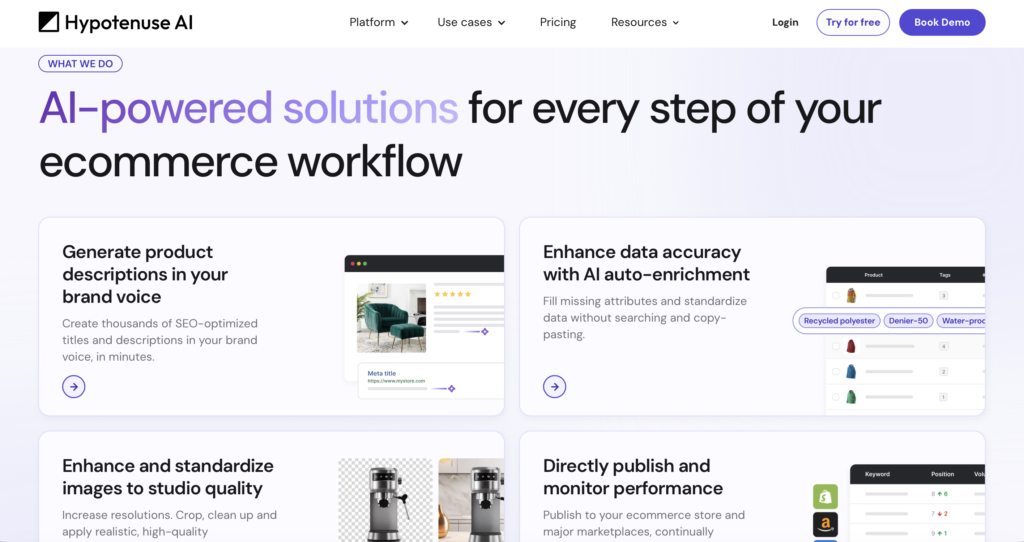
Hypotenuse AI is an AI content platform built for e-commerce businesses and the agencies that serve them. Its core capability is generating product descriptions, catalog copy, and marketing content from product data — at volume. Upload a spreadsheet of 500 products and it returns 500 descriptions, each incorporating the relevant attributes and optimized for your chosen channel.
Beyond the catalog engine, it includes HypoChat (an AI research and writing assistant), HypoArt (AI image generation and editing), SEO and GEO optimization tools, and integrations with platforms including Shopify, WordPress, Wix, Webflow, Amazon, and Klaviyo.
As of June 2026, Hypotenuse AI offers two plans — Basic and Ecommerce Enterprise — both on custom pricing. There are no publicly listed prices. If you want to use the platform, you start with a free trial or contact sales.
That positioning tells you something important about who this tool is built for. It is not a self-serve, credit-card-and-go platform for individual writers. It’s an enterprise content infrastructure product.
Key Features
Bulk Product Description Generation This is Hypotenuse AI’s defining capability. The platform accepts CSV and XLSX imports in its own format, processes product attributes at scale, and returns consistent, structured copy across hundreds or thousands of SKUs. For e-commerce teams managing large catalogs — fashion, homewares, consumer electronics, beauty — this is a genuine operational tool, not just an AI writing assistant. Output quality on product descriptions is strong: specific, varied, and significantly better than general-purpose AI tools attempting the same task.
HypoChat HypoChat is Hypotenuse AI’s conversational research and writing assistant. On the Basic plan it has usage limits and supports up to 30 document uploads for context. The Ecommerce Enterprise plan unlocks unlimited HypoChat access and custom document upload limits. It functions similarly to Claude or ChatGPT but with a tighter focus on content and marketing tasks, and the ability to reference brand documents directly.
HypoArt (AI Image Generation and Editing) HypoArt provides AI image generation within the platform. The Basic plan includes up to 1,000 HypoArt images. The Enterprise plan adds a bulk AI image editor — useful for teams producing product imagery at scale alongside written content. Image quality suits content marketing and product visuals adequately; it won’t replace Midjourney for high-end creative work.
SEO and GEO Optimization SEO and GEO (generative engine optimization — optimizing content for AI search results) features are available on the Ecommerce Enterprise plan. For brands managing organic visibility alongside catalog content, having these in the same platform reduces tool-switching. Basic plan users don’t have access to these features.
CMS and Platform Integrations Hypotenuse AI integrates with WordPress, Shopify, Wix, Webflow, Amazon, Medium, and Klaviyo. The Enterprise plan adds custom PIM, ERP, and DAM integrations for teams with more complex tech stacks. For e-commerce businesses publishing directly to storefronts and CMS platforms, these integrations save meaningful production time.
Enterprise-Grade Security and Compliance The Ecommerce Enterprise plan is SOC 2 compliant and guarantees that your data does not train the AI model — a meaningful requirement for brands with proprietary product data. The Basic plan stores data securely and users own their content, but SOC 2 compliance is an Enterprise-only feature.
Pricing
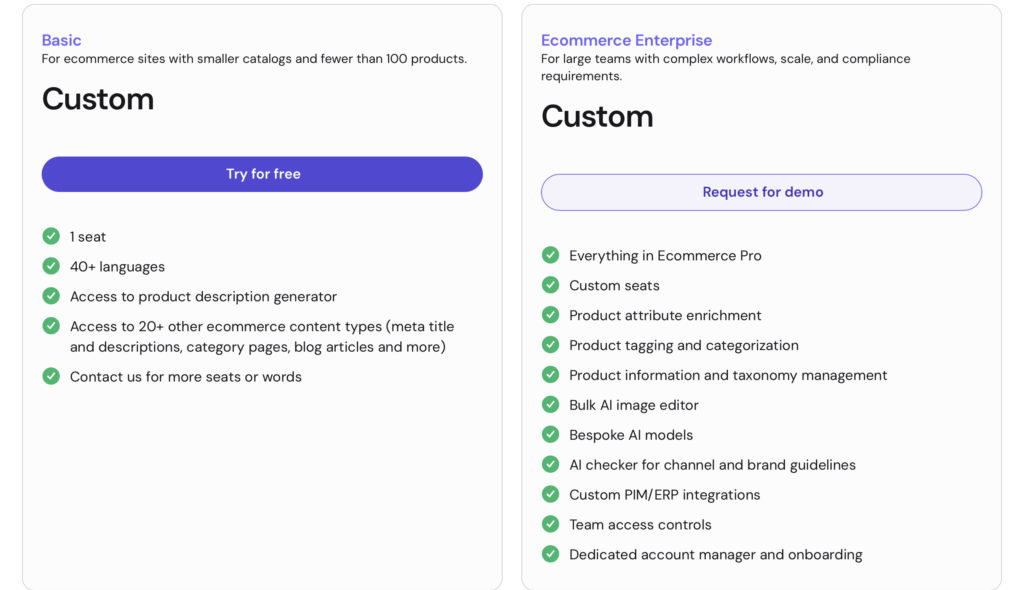
Hypotenuse AI operates on custom pricing across both plans. There are no publicly listed figures — pricing is agreed directly with the sales team based on your catalog size, seat requirements, and feature needs.
| Plan | Price | Seats | Key Features |
|---|---|---|---|
| Basic | Custom | 1 | Product description generator, 40+ languages, bulk CSV/XLSX import, HypoChat (limited), 30 document uploads, 1,000 HypoArt images, blog and social content tools, email and live chat support |
| Ecommerce Enterprise | Custom | Custom | Everything in Basic, plus: team access control, knowledge AI, bespoke brand voice, SEO and GEO optimization, attribute enrichment, tagging and categorization, taxonomy management, PIM and ERP integrations, bulk AI image editor, bespoke AI models, DAM, SOC 2 compliance, dedicated account manager |
To get pricing, start with the free trial or contact sales directly at hypotenuse.ai.
Who It’s Best For
- E-commerce businesses with substantial product catalogs who need consistent, structured product descriptions generated at speed and scale
- Retail and consumer goods brands managing content across multiple channels — Shopify, Amazon, Webflow — who benefit from native integrations
- E-commerce agencies producing catalog copy for multiple clients who need team access controls and brand voice tools (Enterprise plan)
- Brands with compliance requirements around data security who need SOC 2 assurance (Enterprise plan only)
Who Should Look Elsewhere
- Bloggers and independent content creators whose primary output is articles and long-form content. Hypotenuse AI’s feature set and pricing model are not built for this use case — Jasper, Writesonic, or Claude cover it better and with transparent pricing.
- Freelancers and solopreneurs looking for a self-serve AI writing tool with a clear monthly price. The custom pricing model and sales-led process adds friction that doesn’t suit individual users.
- Anyone on a tight budget who needs a free or low-cost entry point. Rytr at $9/month or Copy.ai’s free tier serve general short-form needs without requiring a sales call.
- Performance marketers focused on ad copy with conversion data. Anyword’s predictive scoring is a capability Hypotenuse AI doesn’t offer.
Hypotenuse AI vs Competitors
| Hypotenuse AI Basic | Jasper Creator | Writesonic Starter | Anyword Starter | |
|---|---|---|---|---|
| Pricing | Custom | $49/month | ~$20/month | $49/month |
| E-commerce Focus | Excellent | Moderate | Low | Low |
| Bulk Catalog Generation | Yes | No | No | No |
| Long-form Blog | Good | Excellent | Good | Moderate |
| Free Plan | No (trial) | No | Limited | No (trial) |
| CMS Integrations | Shopify, WP, Wix, Amazon | WordPress | WordPress | WordPress |
| Best For | E-commerce catalogs | Long-form content | Balanced writing | Ad copy optimization |
For e-commerce content specifically, Hypotenuse AI has no direct competitor at a comparable feature depth. For general-purpose AI writing, the comparison tilts sharply toward tools with transparent, self-serve pricing.
Final Verdict
Hypotenuse AI’s pivot to a fully custom-pricing, sales-led model in 2026 makes it a more clearly enterprise product than it was a year ago. That’s not a criticism — it’s an honest signal about who it’s built for.
If you’re managing a large e-commerce catalog, running an agency producing product content at scale, or need a platform that integrates directly with your PIM and ERP infrastructure, Hypotenuse AI is one of the most purpose-fit tools available. The bulk generation, CMS integrations, and enterprise security features are genuinely strong.
If you’re a blogger, freelancer, or small business owner looking for a straightforward AI writing tool with a visible price tag, start elsewhere. Jasper, Writesonic, and Rytr all offer transparent plans, self-serve onboarding, and strong output quality for general content needs.
Score: 7.6/10
FAQs
How much does Hypotenuse AI cost? Hypotenuse AI uses custom pricing across both its Basic and Ecommerce Enterprise plans. There are no publicly listed prices — you’ll need to contact sales or start with a free trial to get a quote. Pricing is based on your catalog size, seat count, and feature requirements.
Does Hypotenuse AI have a free plan? No. Hypotenuse AI offers a free trial to test the platform, but there is no ongoing free tier. Both current plans (Basic and Ecommerce Enterprise) require a sales conversation for pricing.
Can Hypotenuse AI generate product descriptions in bulk? Yes — bulk product description generation via CSV and XLSX import is one of its core features and the primary reason e-commerce teams choose it over general-purpose AI writing tools.
What integrations does Hypotenuse AI support? Hypotenuse AI integrates with WordPress, Shopify, Wix, Webflow, Amazon, Medium, and Klaviyo on the Basic plan. The Ecommerce Enterprise plan adds custom PIM, ERP, and DAM integrations.
Is Hypotenuse AI good for blog writing? It includes blog, social, and general writing tools on both plans, but its feature set and pricing model are designed around e-commerce catalog content. For blog writing as a primary use case, Jasper or Writesonic offer better value with more transparent pricing.
Related articles:
Pricing verified June 2026.